
Basing

In general I get my bases from Litko and use the 1.6mm plywood bases and the heavy duty magnetic base bottoms.* Also of note is that while my rectangular bases are purchased in inches, my circular bases seem to be a mix of inches and mm. Not sure what happened there, but the difference between 1 inch and 25mm is negligible. I also 3D print my bases when I need unusual sizes or I am basing 25mm skirmish type figures or those that come from Games Workshop. The main reason for the printing of the bases is to give me a solid foot to stick on the heavy duty magnetic base bottom, a problem I foresee when I get around to doing this with my Napoleonic armies, which are based (as purchased) on some strange plastic bases that may require some surgery. (or worse a rebase)

I use PVA glue throughout the basing process, probably because I have rebased some of the figures multiple times in their lives and though I do hope to never again using PVA does facilitate this if the need arises. I also often buy painted miniatures through Hinds in the UK, or off eBay, and if others have done the same it makes the process of integrating these preloved figures into my own collection all the easier.

Basing is all about waiting, each step in the process is either punctuated by a long or a short wait. So having something to distract you during this time is vital to maintaining progress. The only thing that really changes is the colours I use and that depends on the period, or maybe the theatre, if a periods conflicts happened across a wide area.
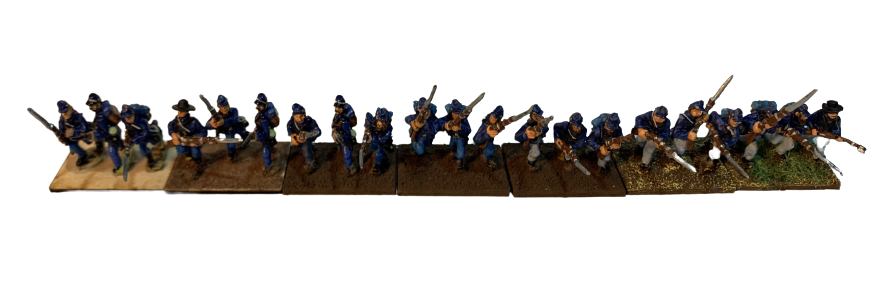
Basing steps (left to right) 1. PVA glue to base, long wait. 2. PVA brown sand, long wait. 3. Base colour applied to cover sand and base edges, long wait 4. Army Painter Anti-Shine Matt Varnish (if needed), long wait. 5. Any colour updates for figures if needed (eg. hats and pants for the Union), short wait. 6. Dry-brush Highlight colour, short wait. 7. PVA randomly applied, sprinkle on flock, long wait. 8. (not pictured) Attach magnetic base, no wait.

ACW: Base: raw umber over brown art sand. Highlight: dry-brush naples yellow. Gun Bar standard flock mix.

Napoleonic’s & Ancient Greeks: Base: yellow ochre over plain sand. Highlight: dry-brush white. Woodlands Scenics light green anti-static grass. (for Peninsular forces)

Dwarves: Base: matt black over art sand. Highlight: dry-brush citadel ulthuan grey. Tajima gold grass tufts.

I do wonder about standardising these colours, since while I do feel the basing should in someway represent the theatre, I don’t really intend to have a Peninsular British force and a 100 days British force just to have “theatre appropriate” bases. Likewise my planned Australians for Malaya could also double for the Fall of Crete, but the base colour would be different. I wonder how others have handled this? Is it just ignored? Maybe bases could be tailored in someway using small movement trays, which might work for WWII and skirmish level games, but probably not for the more Rank and File style periods.

Also I have to give Mark a shoutout, as it was a comment from him that kind of inspired this post as a “how to” record the way I did something, in case I ever return to add to a project. Obviously I am hoping this method is a little better than the scraps of paper I had been utilising.

* this is kinda a new addition to me, I never had to move my armies anywhere in the past so never needed a way to secure them while in transit, so while I am not sure if I needed it, I opted for “heavy duty” as an added level of security.

Limber Fortnight

I have not adopted a new fitness regime nor have I decided to embrace Yoga for the week, rather inspired by Der Alte Fritz and his Limber Day, I have decided to embrace the fact I need want to have limbers represented on my ACW battlefields. Since I have given myself a fortnight (two weeks for those who don’t do English-English slang) to not only base all the limbers I have, but also some wagons, which can serve as both objective markers and heavy ammunition resupply markers if I use the Fire and Fury rulesets.

The plan is to have these done in the next two weeks. Which given that it is approaching the end of my work year, may not be the most realistic as it’s usually the craziest time at work*. But a deadline is often just the inspiration I need, even more so, if I state it rather publicly, rather than just set an arbitrary number in my head that I can soon forget or ignore. (to help with this I have scheduled a post in 2 weeks, that will either be an update of said goal, or a post with a rather hollow sounding question, how did I do?)

So what do I have to do?

Set up ready for the basing and final painting touchup to begin.

And do I need anything more?

Probably more base colour paint, so a trip to Art Friend is in order. And looking at the above photo I realise I am 4 limbers short for both the USA and CSA forces if I want to field one per gun model. But since I don’t have them at this time, they will have to be the subject of some future post.

ACW Bases: PVA draft animals. PVA brown art sand. Raw umber wash. Naples yellow dry-brush. Custom flock blend along edges to give impression that the base is a road. (NOTE: two parallel dirt trails split by grass is a feature of car driven tracks, with wagons the grass line was where the draft animal walked, most wagons being single drawn.)

* Added to which I do get the second vaccine jab later this afternoon, and I have heard that it can give some people a few days of illness, so hopefully this will not be the case and I won’t lose any more time to COVID, but even if I do, small price to pay for being able to travel home and see my parents.

Lest we Forget

They shall grow not old,
as we that are left grow old;
Age shall not weary them,
nor the years condemn.
At the going down of the sun
and in the morning
We will remember them.

On the 25th April 1915, members of the Australian New Zealand Army Corp landed on the Gallipoli Peninsula at what was to later become known as ANZAC Cove. Today on this day we remember those brave souls who made the ultimate sacrifice in service to their country, not just in the Great War but in all conflicts. Although today is specifically one of remembrance for the fallen of both Australia and New Zealand, personally this day is one in which I remember all, regardless of nationality, who have served or continue to serve.

In my country it is unusual for servicemen to receive acknowledgement while in uniform, not so in other countries, and maybe non so much as the United States, so in borrowing a turn of phrase oft uttered in America, if you have served, continue to serve, or even one day hope to serve: Thank you for your service.