Today is the anniversary of the death of Napoleon.*
The figure pictured here was painted by my brother nearly 33 years ago as a “good luck” present as I left home for the RMC-Duntroon. The figure has followed me around the world, no longer on its base, and the sabre is showing definite signs of a much needed touch up. It was painted at a time, before washes, inks and shades, it is the simple application of patience and a very dry brush. I have a few figures painted all those years ago by my brother mostly they are fantasy figures, generally of the old Citadel range and all painted with the same techniques.
Next to the ACW infantry bust my father made while doing his retirement art-diploma, this figure is the one most valued in my collection as it represents my very introverted and reserved brother showing me he cared and he would miss me.
I’ve been meaning to give Napoleon a new base and possibly a new brass plaque, but on the later I am conflicted. I also think a nice bell jar or glass cover to protect him from the knocks of the world is in order. And further I think I should prioritise this and then send a photo to my brother just to let him know that Napoleon is still with me and is very much valued.
* French Napoleonic 1/72nd ESCI troops were the first army ever on my lead pile, long gone, but fondly remembered.
I started this blog quite some time ago with the idea of charting my progress in designing and printing some 3D terrain items. And to be fair, until recently, that’s where it kinda stopped, a hiatus of a year with very little progress, or at least progress that was shared or recorded.
When I posted Antietam 3D and Dunker Church I it was done with the idea of keeping a record of research as I tried to turn a real building into a facsimile that would be representative on the tabletop. I wanted to adhere to the idea that building would be “usable, printable and accurate”, pretty much in that order all while knowing that I would very often get “hung up” on the accurate…probably the reason I put it last.
So this is just an update post, after many prints and much research, I finally have a design that I think represents my ideas and “looks about right” for the tabletop. It went from being a two part print to a three to avoid overhangs when FDM printing, and was recently reworked to include bevelled sills to avoid the hanging (or drooping) threads while printing* after a test print for my Greek Galley found it worked great. Added to which I recently changed the colour of the PLA I was using and have to say, “I love printing in brown” (or grey). The pigment used to colour the plastic does have an impact on the strings and hairs that adhere to a print, just as much as room temperature and humidity can also have an effect on print quality.
So while I would like to create a battle damaged example, at the moment, I am content to move onto another project for a bit, just to help satisfy my inner wargaming butterfly. But for now, a teaser, and some waiting, as the roof will take 12 hours to print with the settings I use, and then I still have those limbers, before I apply some paint.
In general I get my bases from Litko and use the 1.6mm plywood bases and the heavy duty magnetic base bottoms.* Also of note is that while my rectangular bases are purchased in inches, my circular bases seem to be a mix of inches and mm. Not sure what happened there, but the difference between 1 inch and 25mm is negligible. I also 3D print my bases when I need unusual sizes or I am basing 25mm skirmish type figures or those that come from Games Workshop. The main reason for the printing of the bases is to give me a solid foot to stick on the heavy duty magnetic base bottom, a problem I foresee when I get around to doing this with my Napoleonic armies, which are based (as purchased) on some strange plastic bases that may require some surgery. (or worse a rebase)
I use PVA glue throughout the basing process, probably because I have rebased some of the figures multiple times in their lives and though I do hope to never again using PVA does facilitate this if the need arises. I also often buy painted miniatures through Hinds in the UK, or off eBay, and if others have done the same it makes the process of integrating these preloved figures into my own collection all the easier.
Basing is all about waiting, each step in the process is either punctuated by a long or a short wait. So having something to distract you during this time is vital to maintaining progress. The only thing that really changes is the colours I use and that depends on the period, or maybe the theatre, if a periods conflicts happened across a wide area.
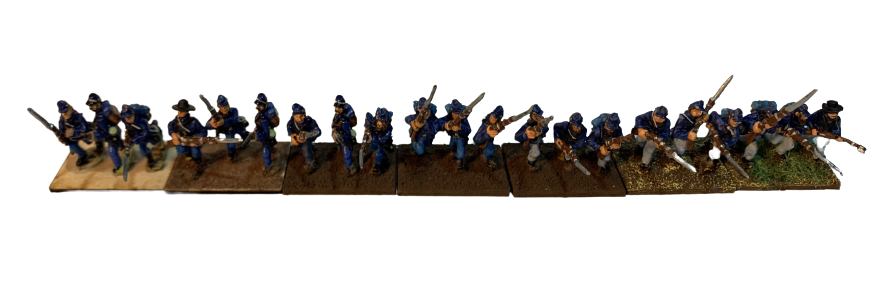
Basing steps (left to right) 1. PVA glue to base, long wait. 2. PVA brown sand, long wait. 3. Base colour applied to cover sand and base edges, long wait 4. Army Painter Anti-Shine Matt Varnish (if needed), long wait. 5. Any colour updates for figures if needed (eg. hats and pants for the Union), short wait. 6. Dry-brush Highlight colour, short wait. 7. PVA randomly applied, sprinkle on flock, long wait. 8. (not pictured) Attach magnetic base, no wait.
ACW: Base: raw umber over brown art sand. Highlight: dry-brush naples yellow. Gun Bar standard flock mix.
Napoleonic’s & Ancient Greeks: Base: yellow ochre over plain sand. Highlight: dry-brush white. Woodlands Scenics light green anti-static grass. (for Peninsular forces)
Dwarves: Base: matt black over art sand. Highlight: dry-brush citadel ulthuan grey. Tajima gold grass tufts.
I do wonder about standardising these colours, since while I do feel the basing should in someway represent the theatre, I don’t really intend to have a Peninsular British force and a 100 days British force just to have “theatre appropriate” bases. Likewise my planned Australians for Malaya could also double for the Fall of Crete, but the base colour would be different. I wonder how others have handled this? Is it just ignored? Maybe bases could be tailored in someway using small movement trays, which might work for WWII and skirmish level games, but probably not for the more Rank and File style periods.
Also I have to give Mark a shoutout, as it was a comment from him that kind of inspired this post as a “how to” record the way I did something, in case I ever return to add to a project. Obviously I am hoping this method is a little better than the scraps of paper I had been utilising.
* this is kinda a new addition to me, I never had to move my armies anywhere in the past so never needed a way to secure them while in transit, so while I am not sure if I needed it, I opted for “heavy duty” as an added level of security.




 The Gun Bar